Escaping to Gibraltar Aboard the Oakrest
Promise at DawnEscaping to Gibraltar Aboard the Oakrest is the improvised wartime flight of Romain Gary and two fellow trainees from Casablanca to Gibraltar. With their route to England seemingly closed, they reached a departing cargo boat by disguising themselves as Polish soldiers and persuading the officers on duty to let them aboard. The escape briefly restored their hopes of continuing the fight, only for their arrival to coincide with news of the destruction of France’s naval units at Mers-el-Kébir.
Stranded in Casablanca
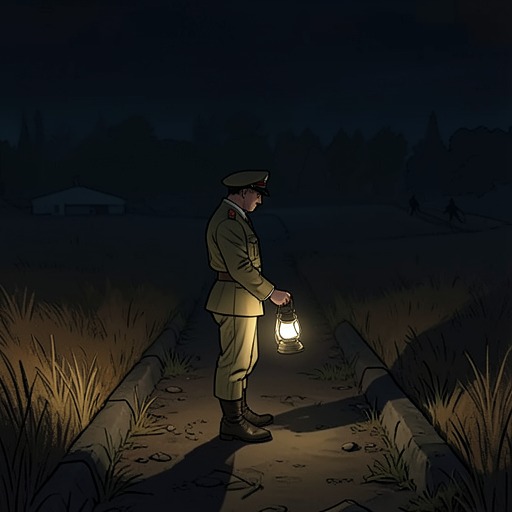
After leaving the camp, Romain Gary reached Casablanca carrying a newspaper-wrapped supply of dill pickles, a small comfort from the journey. At the Place de France he encountered Forsans and Daligot, two trainees from the flying school who, like him, were trying to find a way to England. The three pooled their efforts and spent the day searching for a route out.
The harbor gates were guarded by gendarmes, and the absence of Polish uniforms in the streets seemed to confirm that the last British ship carrying Polish troops had already sailed. By about eleven that night, the three men were standing beneath a gas lamp in deep discouragement. Romain Gary told himself that he had done all he could and that the impossible could not be demanded of anyone. He had begun to yield to fatalism, and turned instead to the promises of future victory that Romain Gary’s mother had made to him: if those promises were to mean anything, he felt, she would have to find a way out of this predicament.
A passage won by improvisation
A Polish corporal appeared as if from nowhere. The corporal explained that the British cargo boat Oakrest, carrying Polish troops from North Africa, was due to sail at midnight; he had come ashore to buy delicacies to supplement the troops’ rations. Romain Gary read this unlikely conjunction as an intervention on his behalf, linking the corporal’s arrival to the assurances of Romain Gary’s mother.
The corporal supplied Forsans with a Polish tunic and Daligot with a Polish cap. Romain Gary had no uniform, so he shouted Polish orders to his companions as they passed the harbor guards. Two Polish officers on duty helped them up the gangplank after Romain Gary gave them a dramatic, whispered account of a supposed intelligence mission. The escape depended on a mixture of borrowed authority, quick invention, and the officers’ assistance; it was not a formal passage arranged for the three trainees.
The crossing and its reversal
The men spent a quiet night at sea in a coal bunker, lulled by dreams of glory. Romain Gary’s fantasy of entering Berlin on a white horse was cut short when a Polish bugle woke him. The contrast between that imagined triumph and the cramped, improvised passage captures how quickly aspiration and circumstance alternate in the episode.
Morale aboard the boat took a declamatory turn: the men imagined their English allies waiting for them and pictured themselves confronting those who sought to enslave humanity. Romain Gary acknowledges the grandiosity of this language while also noting its practical effect: it helped sustain them. The next day, the Oakrest reached Gibraltar as the fleet returned from the Attack on the French Fleet at Mers-el-Kébir. The news that France’s finest naval units had been sunk struck the escapees as a betrayal of their last hope, turning their safe arrival into an immediate political and emotional blow.
Providence, performance, and precarious hope
The episode is shaped by a repeated movement between apparent chance and deliberate performance. A corporal ashore for provisions becomes, in Romain Gary’s interpretation, the agent of the rescue promised by Romain Gary’s mother; a borrowed tunic, a cap, and shouted orders then convert that chance encounter into a passage through the guarded harbor. The escape is neither a planned military operation nor a secure arrival in England: it is a fragile opening made possible by improvisation and help from others.
Its ending refuses uncomplicated triumph. The crossing carries the men to Gibraltar and temporarily revives their hopes of continuing the fight, but the news at landfall shows that escape from one danger does not bring relief from the larger crisis. The white-horse dream, the coal-bunker reality, and the sinking of France’s naval units place heroic aspiration beside defeat without making either disappear.